I'm somewhat familiar with John Updike's short stories and a novel of his called "Rabbit Run", so I think I'm finally at that point where I can make critical assessments on his style and things he likes to throw in his writing. This is strange and new because this is written word I'm talking about and I've never been that avid a reader despite the creative writing minor I've been striving for the past 3 years to obtain. Isn't that funny?
Updike's descriptions are incredible. This man would take the most mundane objects and scenes and describe them so vividly that you could envision it perfectly in your mind. He wrote a short story called "A&P" that takes place in a grocery store. He describes each aisle, and not just how it looks. What are on the shelves, what those things look like, what they do, why they are there, he writes these descriptions so wonderfully. He doesn't miss a single detail AND (and this is a big AND) he writes them down in a way that doesn't bore you. Not always areas and places, but also mindsets, what the protagonist maybe thinking, thoughts so common we might have thought them ourselves. Good in smaller increments, but dangerous in some of his longer novels. In "Rabbit Run" it would feel like entire sections of the book are nothing more than descriptions and that is something that is easy to get overwhelmed by. 3 pages about one old lady's flower garden is enough thank you.
Updike's Protagonists are assholes. Every single character that we have the pleasure of having the perspective of (from what I've read) is someone who is just a total jerk and more times than not, their own worst enemy. Back to "Rabbit Run", the man (Harry Angstrom) gets fed up with his family (pregnant wife and son) and decides to leave home to better his own life because he is unhappy. Yes, why don't we all throw our responsibilities to the wind and do whatever the hell we want? And that is only the beginning, he constantly tries to leave but then finds himself coming back over and over again throughout the course of the book, for one reason or another. Guess what he ends up doing again at the end of the book? We'll get to that later.
In the short story "Seperating" Updike has the main character Richard, a man going through a seperation with his wife who have to break it to their family. At first, he seems shaken by the entire ordeal and we begin to feel some sort of sympathy for him only to realize later one that the one who wanted the separation was in fact him. So this entire time we have the guy painted and gussied up to be the paragon of fatherhood only to find out that he is far from it, that he is in fact human as well.
Updike's Protagonists never accomplish anything. It's like no matter what these characters go through, no matter how challenging or rewarding the hardships are they just don't learn anything from their experiences or their mistakes. Harry Angstrom keeps on running over and over and at the end of the story guess what? He is still running away, selfishly trying to make his life better as he forsakes everything else. Over the course of the sequels to this story, there is some progress made by this character so not all hope is lost. Then we have the Richard from "Separating." He wants to break off the relationship with his wife, they don't even enjoy each others company anymore. And why does he want to do this? When confronted by his son at the end of the story who asks the simple question "why?" he doesn't have an answer. HE DOESN'T EVEN REMEMBER THE REASON ANYMORE. Why all the stress? Why all the tears? He doesn't even know why or what he is doing.
And finally we have the young man from "A&P", who has his eye on a lovely lady in a bikini who happens to walk into the store one day and goes as far to quit his job in hopes of impressing her after his manager kicks her out for the sake of public decency. His mind set akin to "Hey, if I support her poor decision to wear minimal clothing in public can I get in her pants?" Does this brash and bold move get the girl in the end? Worked as well as a screen door on a submarine and our hero is unemployed. Way to be champ.
The women Updike writes are cold. Almost all the girls I've seen this man write seem so unfeeling and judgmental as all the men he writes seem to be so passionate about everything. This is a common formula for his cast of characters, best illustrated in "Seperating". We have the father and the sons acting very emotionally about the entire separation while the girls are general complacent about the whole thing. No real remarks to make, no protests or anything, complete acceptance of the facts presented to them. They are nearly impossible to get behind as characters because of this, which helps readers relate to the often male protagonists he places in these types of events.
Now, I find Updike's writing to be a pleasure most times to read, but sometimes it can feel overwhelming, especially with novels. I enjoy his short stories, much more compact and compressed for my liking. Long story short, the man knows how to write and that is the important thing. But if you need to know anything about any of his works, the points above will pretty much tell you the basics.

Showing posts with label Opinion. Show all posts
Showing posts with label Opinion. Show all posts
Wednesday, October 13, 2010

Monday, August 23, 2010
Triforce Logic
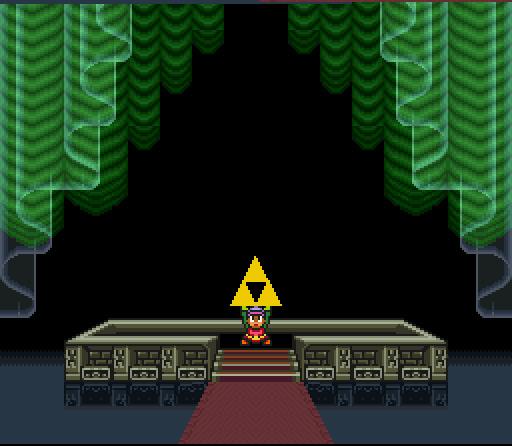 So I briefly made a mention of something I have dubbed "Triforce Logic." Allow me to elaborate on how much of a nerd I am. The Triforce comes from the Legend of Zelda series, it's the almighty, wish-granting, deus-ex-machina artifact forged by a triad of goddesses that is made of up of three separate but equal units (representing power, wisdom and courage) but is sometimes a third is broken into 8 or 12 to prevent some horrible baddie from getting their hands on it. On several occasions, the hero Link has to either collect or reclaim parts of the Triforce in hopes of restoring peace to his beloved Hyrule.
But the number in question here is "3". Three is a good number. I'm not the first person to see three as a good number, in fact most religions have some sort of important thing in relation to the number (Christianity, Hinduism, Taoism, etc.) It is probably from one of these religions that the creators of the Zelda series borrowed the idea for the Triforce. Most likely Christianity, since during the first few games on the Nintendo Entertainment System (or famicom if you happen to be Japanese) Link's shield has a Latin cross on it. In Dante Alighieri's The Divine Comedy, he uses the number three in numerous ways as well with his writing style of terza rima. In fact, it was from my research of Dante's works that I eventually came across this idea.
Back on point: when in doubt, use the number 3. It turns out a lot of things can be categorized into threes in our world. Think about it: Meals of the day (breakfast, lunch, dinner), Parts of a story (beginning, middle, end), that cup of tea you have in front of you (excluding the cup the water, the tea/teabag, sugar/cream/other fixings) and etc. The list can go on and on. Now, I know that there are somethings that don't go into three because there are too many or too little parts. But remember how I mentioned before that the Triforce thirds can be broken down? One of the threes can be broken down into eight. So, we have a 1 that is made up of 8 which if all three were broken down would become 24. See what I did there? So the magic number(s) now are 1, 3, 8 and 24. The lower your number, the better unity I believe you'll have. A series of three is better that a series of 8 or 24, but when 3 is too low for what you are trying to achieve, try the higher numbers to maintain some of that unity.
This is a rough concept of what I call "Triforce Logic." It's not really something to live by but I think it is something to think about whenever you are starting a project. Regardless of whether or not you are into adding philosophy into your work (whatever that may be), keep in mind that the number three may be a nice place to start.
Subscribe to:
Posts (Atom)